Good Work Matters
Dinisha Cherodian
Head of Research at See Research
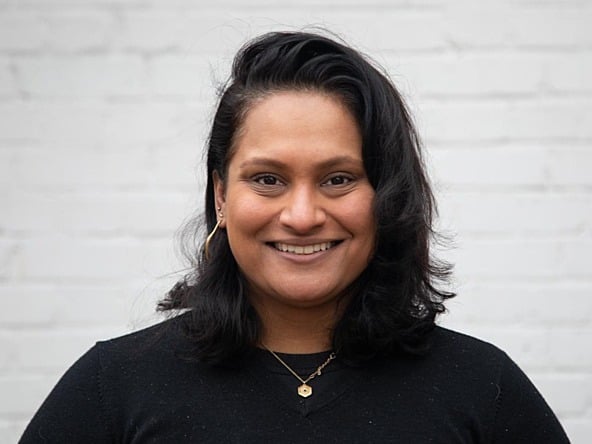
Dinisha Cherodian's CV spans senior roles at Ipsos, Incite and BAMM. Now head of insight at See, she leads key projects, develops new solutions for clients and guides the agency's team – mentoring and supporting their growth. "It's a nice balance between doing and leading," Dinisha explains. "It's a good opportunity to have an impact not just on projects, but on the way the team thinks – building their confidence and helping them grow in their work."
What does 'good work' look like to you – and how has that definition changed over time?
Good work is when you absolutely nail the point – when you get to what the client actually needs. Obvious really, but sometimes it seems not! We do so much analysis, try so many methods, but it's that moment of crystallising it down that matters. Sometimes it's one killer slide or a framework that captures everything. I love that. When you do that, it can shift the way they think and change the direction of the brand or business. Seeing it later in the world – in a campaign or on a shelf – that's the best feeling. I don't think my definition has changed much, but I've honed in on what matters the most. And that's hard, because all the detail and richness is lovely. I love that part, too – when you've been out on fieldwork and come back with all these stories. But the real craft is realising we don't need everything. Just land on the thing that matters; make things accessible and that people can use. That comes with experience.
What kind of process brings out your good work?
It always starts with identifying the core question. This has to run through everything – how you design the methodology, talk to the client, write the guides. Especially in qual or cultural work, you could boil the ocean if you wanted to. You need focus all the way through. Getting to the core question starts with the brief and interrogating it. Half the time, briefs are messy, especially when the client's a few steps removed from the real question. You have to get to that one big thing they actually want to know – that becomes the guiding light. I'm really passionate about analysis sessions – getting everyone in a room, pushing ideas around. It's strange how that's dropped off since Covid. Researchers want to stay behind their laptops, but the best thinking happens when you're talking, challenging, building on each other. You just have to avoid the polite 'good point, good point' sessions. The aim is that moment where someone says something and everyone knows – that's it. It's like alchemy when it happens. I was lucky to be taught that early on. That real analysis isn't about producing loads of stuff; it's about clarity. You see it with younger people coming in straight from uni – you almost have to undo the academic way of thinking. Teaching them how to think in a commercial context is one of the most rewarding parts.
What's a common tension that gets in the way of good work?
The sense that we must always go faster. It shows up in lots of ways. There's the hasty client request for the so-called 'topline'. I'm not a fan! You either give too much too soon, or too little and they lose faith. There's no winning with it, and it always eats into the time you need for real thinking.
In all of this, you need to manage against a feeling of churn – when it turns from thinking into just producing. Projects often start on a real high – the topic's exciting, the team's energised – but it's hard to keep that momentum. People get buried in the process, in the fieldwork and the methods, and lose sight of why it felt exciting in the first place.
This work should feel alive, not like a race to the finish. But again, helping the team to get the better of all of this is such a satisfying part of my role.

How do you hold onto depth when everything's speeding up?
I think you have to be really deliberate about protecting time – and I know that sounds basic, but honestly, that tiny bit of breathing room is the difference between depth and churn. You can turn something around the next day; I've done it more times than I care to admit. But it's never as clear, never as sharp.
I'm also thinking a lot about how AI fits into this. Not in the superficial 'it makes everything faster' sense, but in a more careful way; using it later in the process to pressure-test what we've already found. Not to generate ideas for us, but as a kind of back-of-the-room sense-check – are there angles we've missed, patterns we haven't spotted?
We've got to look for where it can really add value and we have to coach people in how they use it. Not just in the technical sense but in asking, 'does this feel right?' 'Is it actually right?' If you've been doing this for a while, you pick up on things that feel off, but a younger, less experienced person might take it at face value.
We have to be able to stand in front of clients and justify what we're saying. When you're put on the spot, you need to know the thinking holds up. There are definitely opportunities to use AI for efficiencies and as a way of challenging our thinking – we just can't slip into treating it as the all-seeing answer or becoming incapable of thinking without it.
What's something particularly analogue or old-school you still swear by in your process?
Oh, in-person analysis sessions – 100%. I'll always fight for their importance.
I'm talking things on walls. Post-its everywhere. People sitting on the floor. That whole atmosphere where you've all just come back from fieldwork and the energy is high and you're adding, debating, rearranging things. I don't think you can replicate that on a screen. It's efficient as much as it's energising. Two hours like that is worth six hours of everyone sitting alone at home, scrolling through transcripts and getting more and more overwhelmed.
And going into people's homes. I still love that. I also love a focus group where people start as strangers and by the end everyone's laughing and bouncing off each other. There's something so fundamentally human about it – the looks, the pauses, the way someone says something that makes the whole room shift. I can't imagine ever not valuing that.
What's something you've changed your mind about in the last couple of years?
Remote working. During the pandemic I really enjoyed parts of it – the balance, the calm and not constantly trekking into London. I even did a fully remote role for a year afterwards. I was doing good work, but the longer it went on, the more I realised something was missing.
In this industry, being fully remote just isn't healthy. You lose the learning that happens in those in-between moments – someone coming back from fieldwork with a story, the spontaneous chat, understanding what everyone else is working on and what they're enjoying about it, or maybe what they're not. People come into the office for each other as much as for the work.
How are client expectations evolving?
Are they raising the bar or moving the goalposts?
Both – and often at the same time. Budgets are tighter, there are fewer briefs, the competition is fierce and clients want you to get to the strategic heart of something almost immediately. That's raising the bar.
But then something shifts inside their organisation – a stakeholder leaves, a priority changes – and the whole project tilts halfway through. Suddenly everything you'd aligned on needs to be reframed. That's moving the goalposts.
You have to be anchored and agile at the same time, which is not easy. I don't think it was like this a decade ago. The macro pressure – politics, economics – has trickled down to everything. Clients are under enormous pressure, and if they trust you, they'll spend. But trust is harder to earn and easier to lose.
What do you hope we're all talking more about a year from now?
What's missing from the conversation today?
I feel like the AI conversation has swallowed everything whole. It's so binary – pro or anti, excited or terrified – and the nuance has gone missing. So I would say: critical thinking. We need to think about it not just as an abstract idea but as the thing that clients are paying us for.
I'd love us to get back to talking about what we actually bring as humans. The judgement, the questioning, the ability to sense when something is off even if it looks fine on paper. Being conscious of what we actually bring to the table: our expertise. All the stuff you can't outsource. I'm not hearing enough of this right now. I don't see enough people talking about how we think, not just the tools we use.
If you had to delete one overused word from the industry vocabulary forever, what would it be?
I think it has to be 'innovative'. The loose, throwaway way it gets used. Especially when it's used around methodology – give us 'an innovative methodology', 'an innovative approach'. I'm often left thinking, what does that even mean?
What frustrates me is that the team can then get so obsessed with making it sound innovative – like capital-I Innovative – that the whole project gets skewed. Everyone's trying to make the method sexier than it needs to be. And half the time it's just a bit of reinvention or repackaging of something we were all doing years ago, but now with a shinier label on it. We're still talking to people. We're still observing behaviour. There are only so many ways you can do that, you know?
Smart clients don't buy the method anyway. They buy the story, the clarity, the angle that helps them see something differently. That's the value. Not the word 'innovative' stuck in front of something fairly standard.
How do you describe what you do to someone who's miles away from this field?
I usually just say it's helping brands understand their customer – in a really simple way, that's what they want us to do. And that means it's about people. It's going into people's homes, spending time with them, just trying to understand what's going on – the behaviours, the problems, the challenges – and helping brands make sense of that. If I really have to, and if they look a bit confused, I'll mention things like focus groups and surveys. That makes it sound less opaque, if a bit reductive. But really I prefer to stick with explaining that we help these big brands to understand people.
Which trend do you secretly think is total nonsense, even if everyone's pretending to take it seriously?
The very loud anti-AI stance. Not healthy caution – that's fine – but the blanket 'AI is terrible and we should avoid it at all costs' position. It just doesn't reflect reality. I don't think it's a great look when people are publicly anti every single aspect of it. Pick your battles, sure, but you have to try to understand it. I'm never going to be a full expert, that's almost like being a coder. But you still have to engage. And really, we've all been using AI in different ways without realising. It's been part of the conversation for three or four years. Ages back, I remember bringing in machine-learning translations, video tools – things like that. I get that it's scary, because it's moving so quickly but you can't stop it. And the younger ones coming up are so AI-versed they don't even realise they're using it.
What's a recent piece of work – yours or someone else's – that made you feel 'this is what it's all about'?
There's one that really sticks with me – this big piece I did for a budget gym brand. They were so insight-naïve at the start. No real sense of why you'd actually go out and talk to customers beyond a survey. So we did this small, almost 'toe in the water' project first, just to show them the value, and suddenly all these doors opened for them – like, 'Oh, this is why you do qual.'
And then we moved into this really big piece, with a massive semiotics part to it. Which I loved, because the framework we built basically showed them a whole space they could go after that just hadnʼt been on their radar at all. And there were a couple of cynical voices on their side – you always get them – who were like, 'Is that really a thing?ʼ And we were like, 'Yes, it is,ʼ and then quant backed it up and it was all highly satisfying to see unfold.
Fast-forward a bit and suddenly their new ad pops up. And it was exactly the space we'd said they should lean into. The tone, the cues, the whole direction. It was all there. And I had that moment of, 'Yes, this is why we do this.'
How has your work changed you?
It keeps me grounded, constantly. You see lives you'd never normally see. You catch yourself making assumptions and then get them overturned in five minutes. You're forever being pushed out of your comfortable little bubble. I love that. It's why I've always stayed close to the research itself and never wanted to move too far into pure management.
It's also made me realise how much people want to be listened to. You can ask someone about something as mundane as a coffee lid and suddenly they're telling you a whole story. People want to talk – that's something this job has taught me over and over again.
If you could add one question to this interview, what would it be?
Something about how we bring up the next generation of researchers. I keep coming back to this topic, but as someone who I guess now qualifies as 'senior', it feels so important. And I don't buy this idea that AI is going to take those roles away. If anything, it should free people up to think more, so we need to help them on the right path.
Across the agencies I've worked in, you do see different attitudes to how young researchers should progress. And it's always a balance. They often love proper training – the classic 'let's sit down and go through this' – and they get a lot from the theory. But you have to pair that with real work, otherwise it doesn't stick. And that's where it gets tricky, because if they're constantly being thrown in, it can be too much. I'm all for getting your hands dirty, but you also need moments of grounding – without overwhelming them.
Ultimately we have to remember the world they're growing up in isn't the same as ours was. If I try to boil all of this down to one thing, it's about how to guide them so they build proper thinking skills, not just 'how to use AI' skills.
